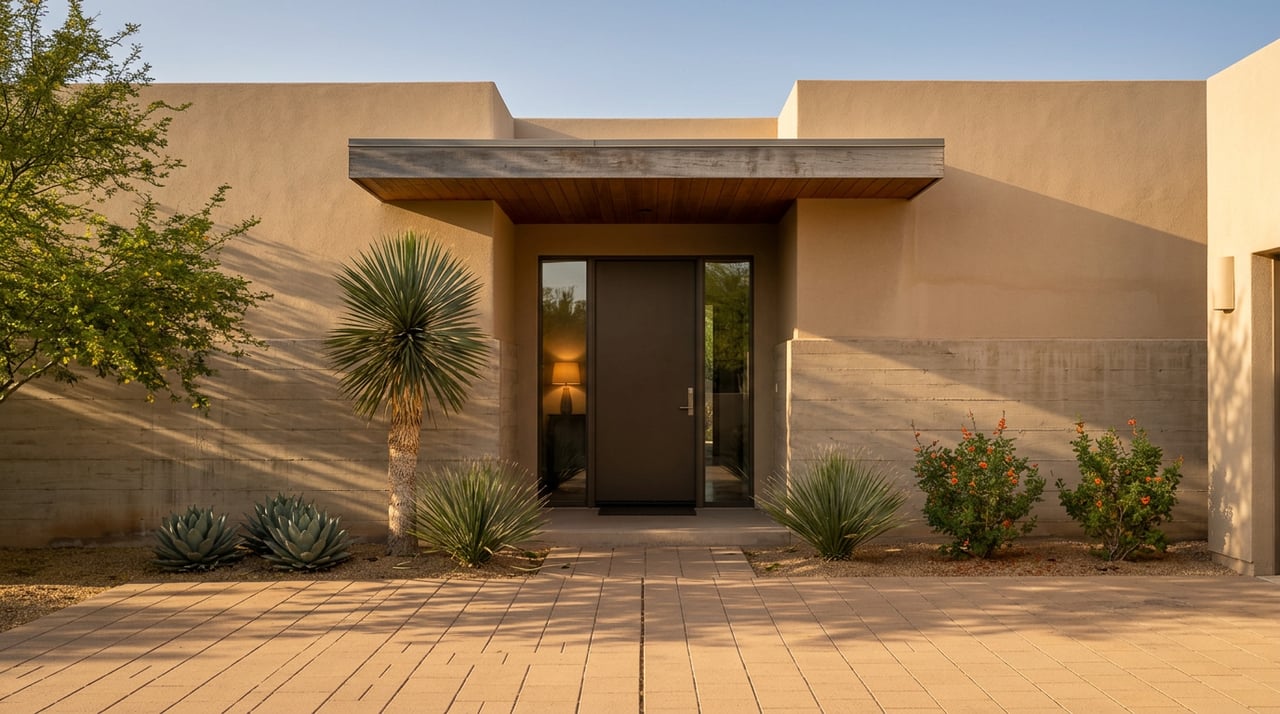
The Phoenix-Tucson Move Runs Both Ways. Here's What That Actually Costs.
September 3, 2026
September 3, 2026
Ask most people which direction the Arizona relocation traffic runs and they will guess the obvious answer: people leave expensive Phoenix for cheaper Tucson, chasing lower prices and a slower pace. That story is only half true. Redfin's own migration data, pulled from homebuyer searches through the most recent quarter tracked, shows the traffic running in both directions at once. Tucson is the single most popular destination for people searching to leave the Phoenix metro. At the same time, Phoenix is the single most common origin point for people searching to move into Tucson.
That is not a typo, and it is not two different housing markets accidentally trading places. It is the same corridor, moving people past each other in opposite directions for different reasons. If price alone explained the moves, the traffic would flow one way. It does not, which means the real decision facing anyone weighing Phoenix against Tucson is more specific than "which city is cheaper."
Roughly one in five Phoenix-area house hunters searched to leave the metro entirely between January and March of 2026, and Tucson was where most of that search traffic pointed. Reverse the lens and Phoenix shows up as the top origin metro for people searching their way into Tucson, ahead of Seattle and Los Angeles.
Two things that both point toward affordability being only part of the answer. Some of the people leaving Phoenix are almost certainly chasing Tucson's lower price floor, its slower commute, or its proximity to the mountains without the summer heat load. But the people moving the other direction, from Tucson into Phoenix, are not doing it because Phoenix is cheaper. They are doing it because something specific in Phoenix, a job, a company, a sector, is worth the higher price of admission. That distinction matters more than either city's median price, because it tells you which question you actually need to answer before you move: are you chasing a lower cost of living, or a specific opportunity that only exists in one of these two places?
Here is where the math gets interesting. Salary.com's cost of living calculators, refreshed in May and July of 2026, put the pay gap between the two metros at about 4 percent. A worker earning roughly $57,619 in Tucson would expect around $62,479 for the same role in Phoenix, a difference of about $4,860.
Compare that to what the same move costs in housing. Over the three months ending in June 2026, Phoenix's median sale price sat at $465,000 against Tucson's $320,000, a gap of $145,000. That is roughly thirty times the size of the raise.
| Metric (3 months ending June 2026) | Phoenix | Tucson |
|---|---|---|
| Median sale price | $465,000 | $320,000 |
| Median price per square foot | $273 | $209 |
| Average offers per listing | 2 | 1 |
| Typical days on market | 52 | 62 |
A generic move for a generic 4 percent raise does not pencil out against a $145,000 price gap, not even close. If the only thing pulling someone from Tucson to Phoenix is "better pay," the numbers argue against it. Something else has to be doing the work.
That something else is sector-specific, not city-wide. Phoenix's economy has been reshaped since early 2025 by a small number of very large, very specific employers, and the pay premium concentrates around them rather than spreading evenly across every job in the metro.
TSMC's north Phoenix chip fabrication plant began production in early 2025. Intel's Chandler campus, just outside the city, employs more than 12,000 people. Recruiting firm LHH, in a 2026 report on the Phoenix labor market, put the region's annual shortfall of qualified semiconductor professionals at 3,000 to 4,000 people, a gap wide enough that it hands real leverage to candidates with the right technical background. The same report lists salary bands for roles feeding that ecosystem well above the generic averages: front-end developers near $127,000, data scientists around $134,000, software engineering managers approaching $183,000.
That is the version of the Phoenix move that actually clears the $145,000 housing gap. A worker landing a semiconductor, aerospace, or senior tech role in Phoenix is stepping into a different pay bracket than the citywide 4 percent average suggests. A worker moving for a lateral office job in a sector that exists in both cities is not, which is a useful filter to run before assuming Phoenix's higher price tag is automatically worth it.
The other piece the citywide median obscures is how much Phoenix varies block to block. Treating "Phoenix" as a single price point flattens a metro where the entry tier and the top tier barely resemble each other.
As of spring 2026, Paradise Valley's median sat above $3.2 million. Biltmore ran near $1.15 million, and Arcadia sat close behind at roughly $1.45 million, both anchored by resort-adjacent land and mature, mid-century housing stock that does not get built new anymore.
At the other end of the same metro, listing data through March 2026 put several submarkets close to Tucson's own citywide median:
None of those three numbers are far from Tucson's $320,000 median. That means the honest version of "moving to Phoenix" is not one decision, it is a choice between a metro that can cost roughly what Tucson costs, or one that costs nearly ten times that, depending entirely on which corridor you land in. Anyone comparing Phoenix to Tucson using only the citywide median is comparing to a number that most Phoenix buyers are not actually paying.
One of those entry-tier corridors picked up a concrete reason to look different than it did before the line opened. Valley Metro's South Central Extension and Downtown Hub opened in June 2025, adding 5.5 miles of light rail south along Central Avenue from downtown Phoenix to Baseline Road, with eight new stations serving the South Central Phoenix corridor. The project was built specifically to address an area where a large share of residents had limited or no access to a personal vehicle, and it turned Valley Metro's single line into a two-line system for the first time.
Ten months after opening, the project kept collecting attention rather than fading into routine infrastructure. In April 2026, it picked up recognition from WTS International, the Arizona Forward Environmental Excellence Awards, and the American Council of Engineering Companies, the kind of sustained follow-on attention that suggests planners and engineers see it as more than a ribbon-cutting.
For a buyer weighing an entry-tier Phoenix corridor against Tucson's median, that is a specific, verifiable change in what the property actually connects to, not a marketing claim about a "growing neighborhood." Transit access is one of the few facts in a relocation decision that gets more certain over time rather than less, since the rail line and its stations are already built and running.
None of this argues for Phoenix over Tucson or the reverse. It argues against treating the decision as a single number. The migration data shows people moving in both directions for reasons that price alone does not explain. The salary math shows a citywide raise that cannot justify a citywide price gap, which means the decision only makes financial sense when it is tied to a specific role in a specific sector. And the submarket data shows that "Phoenix" contains both a price point close to Tucson's own median and one nearly ten times higher, sitting inside the same city limits.
The useful question is not "Phoenix or Tucson." It is which specific Phoenix, tied to which specific job, at which specific price point, and whether that combination beats what you already have in Tucson once you run the real numbers instead of the median ones.
Not based on the pricing data itself. Over the same three months used above, Phoenix's median sale price was still up 3.1 percent year over year, even as inventory has grown and average days on market have lengthened slightly. Migration search data reflects where people are looking, not necessarily where prices are heading.
Not automatically. Transit access is one input among several, and pricing along the corridor still varies by block and by property condition. It is worth asking specifically how close a given listing sits to a station and whether that access has already been priced into the listing, rather than assuming the whole corridor moves together.
If you are weighing a move between Tucson and Phoenix, or comparing either city against somewhere else in Arizona entirely, that is exactly the kind of block-by-block, job-by-job math I Am Home Arizona Group works through with clients every week. David Ramirez, Ricardo Ochoa, and Daniel Monroy cover both sides of this corridor, in English and Spanish, and can run the numbers against your specific situation before you make a decision based on a median that may not apply to you. Reach out for a free home valuation and a conversation about what your budget actually buys on either end of Interstate 10.
Stay up to date on the latest real estate trends.

Partner with a trusted real estate team that blends market knowledge, integrity, and a client-focused mindset—collaborating closely to navigate every stage of the journey with clear communication, careful attention to detail, and a dedication to achieving outstanding results.